Dates
Occupied from approximately I 420; 1 destroyed at the end of the First AgeLocation
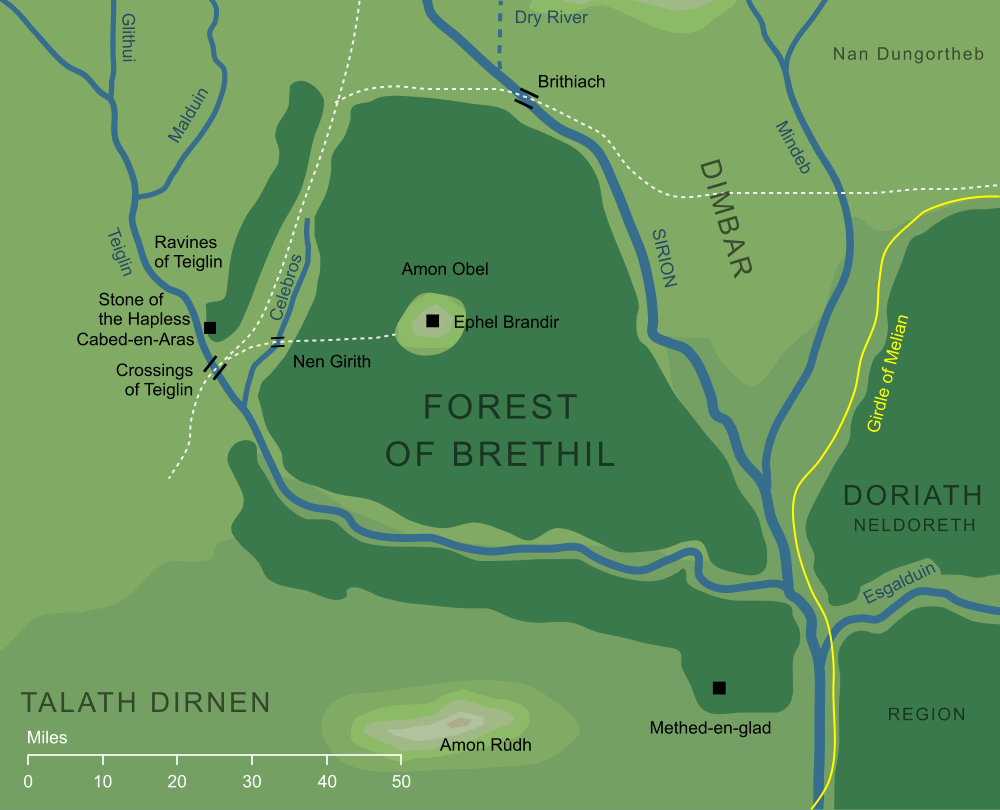
West of Doriath, between the Rivers Teiglin and SirionRace
Division
Culture
Family
Settlements
Source
The stream of Celebros rose within the western forest, and ran into Teiglin near its southwestern borders Important peaks
Pronunciation
bre'thil (th as in English 'breath')
Meaning
Brethil is a reference to a type of tree, either the beech or the birch2
Other names
Indexes:
About this entry:
- Updated 19 March 2014
- Updates planned: 1
|
A forest on the western marches of Doriath. It was occupied in the later years of the First Age by the Edain of the House of Haleth, and it was there that Túrin Turambar slew the Dragon Glaurung.
Notes
1 |
This dating comes from the Grey Annals in volume XI of The History of Middle-earth. The story there varies considerably from the final form (it describes Haleth as a man, and makes him responsible for leading his people from beyond the Blue Mountains directly into Brethil). The form of the tale in The Silmarillion is much more elaborate and extends over several generations, but the year I 420 seems to remain plausible as the date of the settlement of Brethil. |
2 |
The word brethil appears in various contexts where it seems to mean 'birch' (for instance in the name Nimbrethil for the birchwoods of Arvernien). By contrast, in The Etymologies (in volume V of The History of Middle-earth, brethil is said to mean 'beech'. Though Brethil's own trees are never explicitly identified, its immediate neighbour the Forest of Neldoreth was known to be populated mainly by beeches, rather than birches.
It's difficult to reconcile these lines of evidence. Perhaps Tolkien simply changed his mind about the meaning of the word, but left an earlier usage in place. Beeches and birches are related types of tree, and it's possible that the Elves used the word brethil for trees of either kind. |
See also...
Aghan, Algund, Amon Obel, Amon Rûdh, Bald Hill, Bane of Glaurung, Barach, Barahir, Birches, Black Sword, Black Sword of Brethil, Black Sword of Nargothrond, Black Sword of the South, Black Thorn of Brethil, Bow and Helm, [See the full list...]Brandir, Brithiach, Celebros, Celegorm, Crossings of Teiglin, Dimbar, Dimrost, Dor Caranthir, Dragon-King, Dragon-stench, Drúedain, Drúedain of Beleriand, Drughu, Drûgs, Elu Thingol, End of the Wood, Ephel, Ephel Brandir, Fell Winter of the First Age, Finduilas, Folk of Haleth, Ford of Brithiach, Glaurung, Gorthol, Grave of the Children of Húrin, Haladin, Haldan, Haldir, Haleth, Halethrim, Handir, Hareth, Haudh-en-Arwen, Haudh-en-Elleth, Hill of Spies, House of Haleth, Huor, Ladybarrow, Land of Bow and Helm, Larnach, Leap of Dreadful Doom, Lord of Brethil, Maid of Tears, Master of Doom, Men of Brethil, Men of Haleth, Men of the Mountains, Men of the Three Houses, Methed-en-glad, Mound of the Elf-maid, Niënor Níniel, Níniel, Orc-hunters, Orleg, People of Haleth, Rainy Stair, Ravines of Teiglin, River Malduin, River Mindeb, River Teiglin, Sarch nia Hîn Húrin, Sharbhund, Shuddering Water, Sirion’s Vale, Song of Parting, Stone of the Hapless, Tale of Grief, Tear-maiden, The Dragon, ‘The Faithful Stone’, The Highway, The Lame, The Manhearted, Three Houses of the Edain, Tol Morwen, Tûr Haretha, Túrin, West Beleriand, White Mountains, Wildman of the Woods, Woodmen, Woodwose
Indexes:
About this entry:
- Updated 19 March 2014
- Updates planned: 1
For acknowledgements and references, see the Disclaimer & Bibliography page.
Original content © copyright Mark Fisher 1998, 2001, 2008, 2014. All rights reserved. For conditions of reuse, see the Site FAQ.
Website services kindly sponsored by Axiom Discovery aptitude and skill testing.Personality is one part of understanding a candidate's suitability for a role, but aptitude can also be crucial.
|
 SHARE
SHARE