Dates
Constructed in very ancient times, destroyed in the War of Wrath at the end of the First Age, c. I 587Location
Far to the north of BeleriandOrigins
Originally constructed as an outlying fortress to Melkor's great stronghold at UtumnoRace
Founded by Melkor, an Ainu, and peopled by his servants Important peaks
The three peaks of Thangorodrim rose over Angband Pronunciation
a'ngband
Meaning
Usually given as ' Hells of Iron', but the literal meaning is 'iron prison' Other names
Indexes:
About this entry:
- Updated 6 August 2008
- Updates planned: 1
|
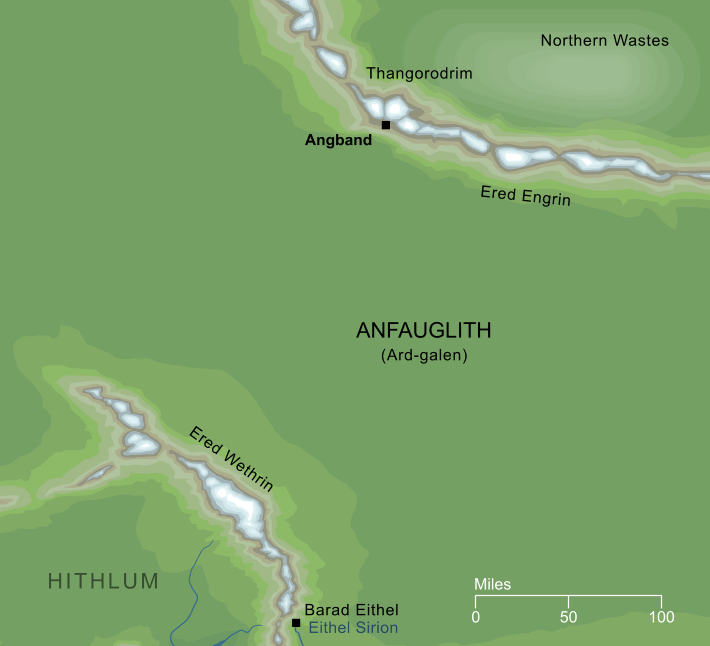
(somewhat conjectural)1
(somewhat conjectural)1
" The wolf howls. The ravens flee.
The ice mutters in the mouths of the sea.
The captives sad in Angband mourn." The History of Middle-earth volume III
The Lays of Beleriand
The Lay of Leithian VII 2200-2202
Angband was a mighty fortified citadel originally constructed by Melkor in the earliest days of the world as an outlying fortress to his northern stronghold of Utumno. Utumno was destroyed by the Valar, and Melkor imprisoned in Valinor for three ages, but on his return to Middle-earth, he took Angband as the seat of his power, and raised the towers of Thangorodrim above its gates.
Angband was beseiged by the Noldor after their return to Middle-earth, but the Siege of Angband was broken at the Dagor Bragollach. It was finally destroyed by the forces of the Valar at the end of the First Age, in the War of Wrath.
Origins and History
Angband was first constructed in the ancient past of Middle-earth,2 originally as an outlying fortress and armoury to the great northern citadel at Utumno. It was commanded from its first construction by Sauron, the chief of Melkor's servants. Angband was built near the northwestern shores of the Great Sea in the range of the Iron Mountains, as a first defence against any attack on Melkor's realm from the Valar in Aman.
When the Valar captured Melkor and took him in chains back to Valinor, Angband was largely destroyed and lay in ruins for many thousands of years, although beneath the ruins lay many hidden chambers in which some of Melkor's servants escaped the Valar's assault. Sauron was one of these, and the Balrogs lay hid with him in Angband's deepest vaults.
Angband re-entered history when Melkor escaped Valinor with the stolen Silmarils: he chose the ruined fortress as his new capital, and rebuilt the Hells of Iron as a base for the dark reign he intended for the lands of Middle-earth.
Soon after the Return of the Noldor to Beleriand, Morgoth took Maedhros by deceit and trickery, and hung him by the wrist from the towers of Thangorodrim above Angband. He was rescued by Fingon and Thorondor, but lost his right hand.
The third of the great battles in the Wars of Beleriand, the Dagor Aglareb, had profound consequences for Angband. Until that time (the year I 60) Morgoth had sent out hosts of Orcs in the hope of taking the Noldor by surprise. The Noldor, though, chased these Orcs back to the very gates of Angband, and slew them to the last creature. From then until the Dagor Bragollach in I 455, a period of almost 400 years, Angband was surrounded by the Noldor; this is the time known as the Siege of Angband.
Appearance and Construction
Angband was primarily an underground fortress, at least after its initial destruction by the Valar in the Years of the Trees. Like its prototype, Utumno, it had many hidden underground chambers and vaults far beneath the earth. Its main features above ground were the three peaks of Thangorodrim, mighty towers of ash and slag raised above Angband's gates after Morgoth's return to Middle-earth.
The peaks of Thangorodrim were hollow, and from them channels and chimneys ran down to the deepest pits of Angband. So, Morgoth could produce poisonous clouds and vapours, as indeed he sent against the Noldor in Mithrim during the first days after their Return.
Notes
1 |
While the map that accompanies The Silmarillion does not show the location of Angband, there are a wealth of hints and pointers in that work to help us to place it with some degree of certainty. Additional material provided in The History of Middle-earth also gives us some useful information about its geography. |
2 |
Probably some 15,000 years or more before the first rising of the Moon and Sun. |
See also...
Aman, Ancalagon, Anfauglir, Angainor, Angrod, Ard-galen, Arroch, Asgon, Balrogs, Barad Eithel, Barahir, Bauglir, Black King, Borlad, Bregolas, [See the full list...]Camlost, Craven, Dagor Aglareb, Dagor Bragollach, Dagor-nuin-Giliath, Dark King, Dark Lord, Dark Power of the North, Dark Throne, Daystar, Deep Elves, Dimbar, Doors of Angband, Dor Daedeloth, Dor-nu-Fauglith, Dragonets, Dragons, Draugluin, Dread Helm, Durin’s Bane, Eglador, Eithel Nínui, Eldar of Hithlum, Elu Thingol, Elves of Beleriand, Elves of the Havens, Enemies Beyond the Sea, Erchamion, Ered Engrin, Ereinion Gil-galad, Evil of the North, Fall of Fingolfin, Fëanor, Fell Winter of the First Age, Fingolfin, Fire-drakes, First Age, Foam-flower, Forest under Night, Forodwaith, Fountain of Tinúviel, Gasping Dust, Gate of Angband, Ghosts, Gil-Estel, Glaurung, Glorious Battle, Gondolin, Gothmog, Great Battle, Great Darkness, Great Echo, Great Enemy, Great Siege, Grond, Grond, Guarded Realm, Haldan, Havens of the Shipwrights, Hell, Hells of Iron, High King of the Noldor, High-captain of Angband, Hound of Valinor, Hunting of the Wolf, Huor, Iron Crown, Iron Mountains, Jaws of Thirst, King of the World, Lammoth, Land of the Girdle, Laughter, Lay of Leithian, Long Peace, Lord of Belegost, Lord of Dor-lómin, Lord of Middle-earth, Lord of the Dark, Lúthien Tinúviel, Melkor, Men of Darkness, Men of Dorthonion, Midsummer, Mines of Moria, Morgoth, Mountains of Iron, Narn i Chîn Húrin, Narrow Land, Northlands, Nothing, Oath of Fëanor, One-hand, Over-heaven, People of Hador, Power of Terror and of Hate, Power of the North, Ramdal, Red Maw, Return of the Noldor, Ruin of Doriath, Sack of Nargothrond, Sauron, Second Battle, Silmarils, Song of Parting, Star of Eärendil, Tale of Grief, The Accursed, The Black, The Bragollach, The Dark, The Empty-handed, The Highway, The North, The North, The Wolf, Third Battle, Three Houses of the Elf-friends, Three Jewels, Throne of Morgoth, Thuringwethil, Ulmo, Union of Maedhros, Urwen, Valmar, Voles, War of the Great Jewels, War of the Jewels, War of the Powers, Wars of Beleriand, Wild Men, Wolf of Angband, Wolf-folk, Wolf-Sauron
Indexes:
About this entry:
- Updated 6 August 2008
- Updates planned: 1
For acknowledgements and references, see the Disclaimer & Bibliography page.
Original content © copyright Mark Fisher 1997-2000, 2008. All rights reserved. For conditions of reuse, see the Site FAQ.
|
 SHARE
SHARE