| Proper Names | The Sun, Sol | | Bayer Designation | None | | Flamsteed Number | None | | HR (BSC) | None | | HD | None | | Constellations | The Zodiac and Ophiuchus | | Right Ascension | Passes across the entire sky in one year; crosses 0h00 at the Vernal Equinox | | Declination | Varies between roughly +23° and -23° | | Mean Distance from Earth | 1 Astronomical Unit
149,597,870 km
92,955,730 miles | | Magnitude | Apparent: -26.74
Absolute: +4.83 | | Spectral Class | G2V yellow dwarf | | Planets in this system | Mercury, terrestrial planet
Venus, terrestrial planet
Earth, terrestrial planet
Mars, terrestrial planet
Jupiter, gas giant
Saturn, gas giant
Uranus, ice giant
Neptune, ice giant
Numerous dwarf planets, asteroids and other bodies
|
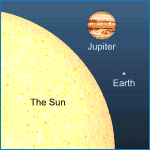
The Sun is far more massive than even the largest other bodies in the Solar System - its diameter is nearly ten times that of Jupiter, and more than a hundred times that of Earth. By comparison with other stars, though, it is relatively small, and belongs to the classification known as 'dwarfs'.

The Sun is the source of energy that makes life possible on its third planet, Earth.
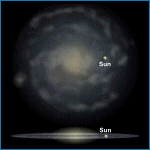
A yellow dwarf star, notable in that it is the star around which the Earth orbits, but otherwise unremarkable. If it lay at a distance of ten parsecs (the standard distance for describing absolute magnitude) it would hardly be visible to the naked eye.
While the Sun may not be powerful in comparison with many other stars, it is still a remarkably luminous body. The temperature at its surface is a little less the 6,000 Kelvin, and its core reaches 15,000 Kelvin. Every second, it consumes several million tonnes of hydrogen to produce 400,000,000,000,000,000,000,000,000 Watts of power. Though many distant stars are much more luminous than this, the Sun is one of the most energetic stars in its immediate stellar neighbourhood.
Because the Earth travels around the Sun in a year-long orbit, from the point of view of an Earth-bound observer, the Sun appears to progress through the sky. This journey always follows the same path, the Ecliptic, which passes through the twelve zodiacal constellations, as well as Ophiuchus, the Serpent Holder. The Sun travels almost exactly one degree across the sky each day, and it has been speculated that this is the reason a circle is divided into 360 degrees.
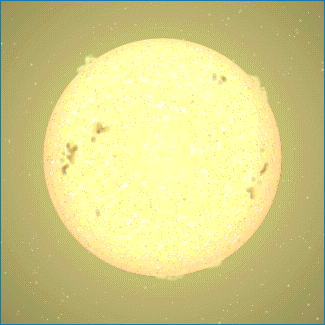
A portrait of the Sun. The darker areas are 'sunspots', temporary cooler regions where the surface temperature is no more than about 3,700 Kelvin, compared with nearly 6,000 Kelvin in the surrounding photosphere.
The Life History of the Sun
About 5,000,000,000 years ago, our region of the Galaxy was very different from its conditions today. It was dominated by a vast cloud that has come to be known as the Solar Nebula. Gravitational effects within the cloud caused a protostar to form, and over a period of tens of millions of years, this collapsed and heated to the point where nuclear processes ignited in its core.
As the matter in the protostar coalesced, it formed into a broad disc shape around the burning central core of the young Sun. The same gravitational effects that had caused the protostar to collapse were at work within the disc, causing the gradual formation of protoplanets, which over millions of years formed gradually into true planets with their own systems of moons and rings: our Solar System.
Since its formation, the Sun has been steadily burning through its reserves of hydrogen fuel. It is now a middle-aged star, and has about another 5,000,000,000 years of life before its fuel reserves are exhausted. At this point, the outer layers of the Sun will expand to form a short-lived giant red star. Eventually, this material will expand outwards into space, creating a planetary nebula (such as the Ring Nebula in Lyra). The core, meanwhile, will collapse upon itself to form a white dwarf of about the same diameter as the Earth, though rather more massive. Eventually, this white dwarf will cool to form a black dwarf - a giant cinder in space, perhaps accompanied by the dead remnants of its planetary system.
|
|