As the Earthorbits the Sun, its poles always point at fixed positions in the sky. The north pole points toward Polaris (the current Pole Star), while the south pole points towards the constellation of Octans. The planet's orientation is fixed relative to the stars, subject to a long slow change over the millennia known as precession.
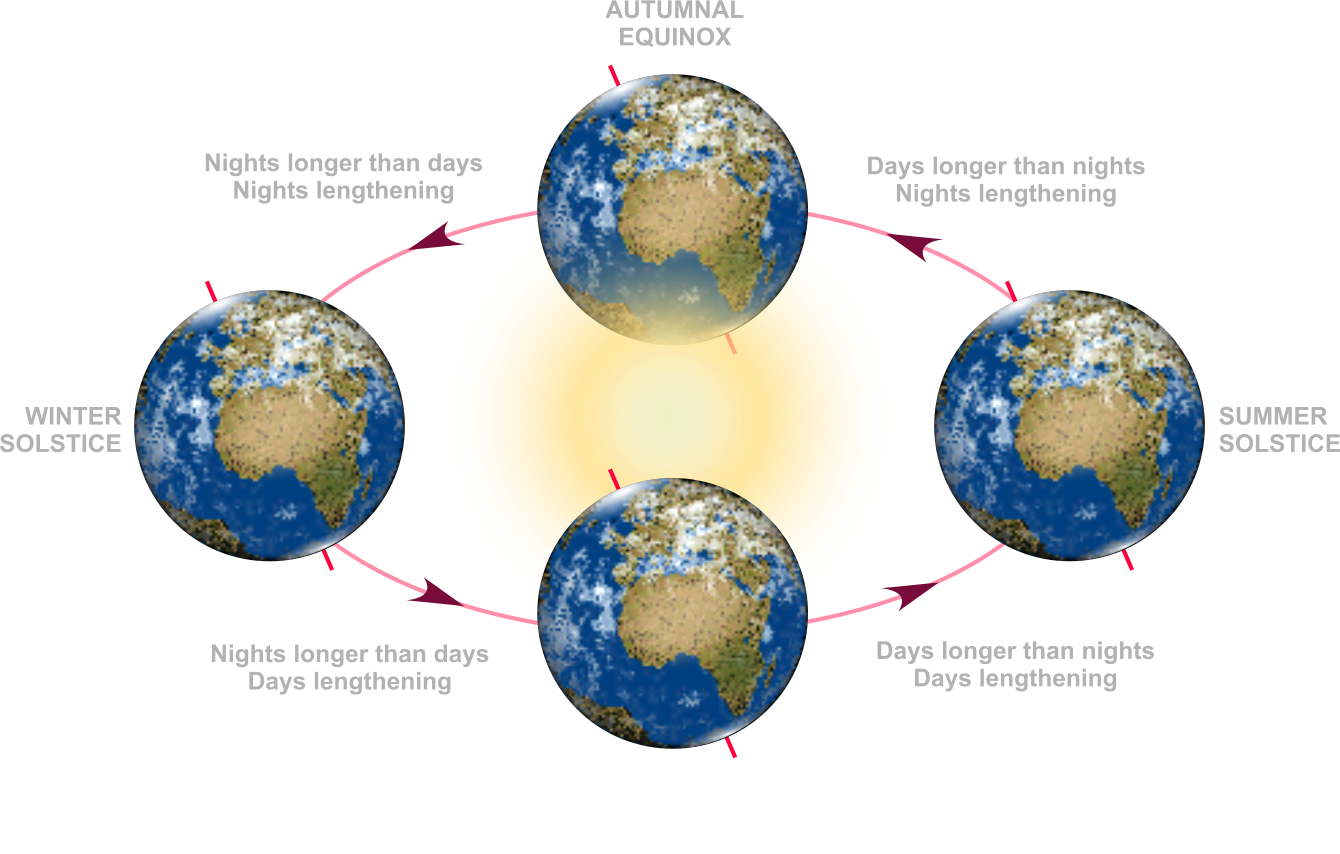
As days lengthen and nights shorten after the Winter Solstice, the Vernal Equinox marks the point where day and night are of the same length. After the Equinox, days will continue to grow longer until they reach a maximum at the Summer Solstice in June.
This fixed inclination means that, as the Earth travels around the Sun, each pole is sometimes angled towards the Sun, and sometimes angled away. From the Sun's perspective, the Earth 'tilts' backward and forward each year, and it is this 'tilt' that causes the seasons.
Table of Vernal Equinoxes
Year
Date and time (GMT)
2022
20 March, 16:34
2023
20 March, 22:25
2024
20 March, 04:07
2025
20 March, 10:02
2026
20 March, 13:45
2027
20 March, 19:24
2028
20 March, 01:16
2029
20 March, 07:01
2030
20 March, 12:51
2031
20 March, 18:40
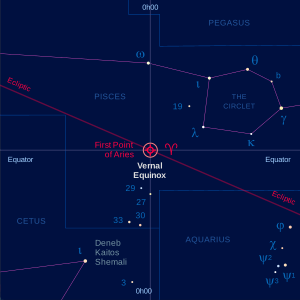
The vernal equinox occurs when the Sun crosses the First Point of Aries at the junction of the Equator and Ecliptic. That point is presently in Pisces, and is slowly moving along the line of the Ecliptic towards Aquarius, at a rate of about one degree every seventy years.
Many of the Earth'sliving systems have adapted to the planet's astronomical cycles. Both of these organisms - butterfly and flower - have developed their own responses to the vernal equinox and the climatic changes it brings with it.
When a pole is oriented towards the Sun, its hemisphere has six months where the Sun is high in the sky, and days are longer than nights (that is, summer). For the other six months, the pole is tilted away from the Sun, which is low on the horizon, and nights are longer than days (winter). These differences are more noticeable at higher latitudes: at the poles themselves, the effects are extreme, and result in months of daylight followed by months of darkness.
The equinox is the point where one season turns to the other. The word is Latin for 'equal night' and refers to the fact that, on the equinox, day and night are of equal length. There are two equinoxes each year, with the vernal equinox usually occurring on 21 March. Vernal comes originally from the Latin word for 'bloom' - it refers to the fact that, in the northern hemisphere, this equinox marks the end of winter and the beginning of spring. The name is less meaningful in the southern hemisphere, where this equinox actually marks the beginning of autumn, but nonetheless the traditional name vernal is commonly retained.



 Show on Sky Map