This starscape belongs to a world in a denser region of the Milky Way Galaxy than our own. The glittering sky is crowded with stars of all types.
Bodies so massive that nuclear fusion occurs within them, emitting vast quantities of energy into space.
There is a minimum mass for a star: roughly 10 × 1028 kg. Below this mass (about a twentieth that of the Sun, or twenty times that of Jupiter), fusion cannot occur spontaneously. Most stars are much more massive than this: the most massive and luminous known are more than two thousand times more so than this minimum value.
Stellar fusion, in most cases, generates energy by fusing hydrogen into helium, though more massive stars may in the later stages of their existence produce heavier elements. Nuclear fusion of this kind is responsible for producing most of the heavier elements of the universe.
The Evolution of a Typical Star
Stars begin their lives among the clouds of dust and gas that form a galaxy's interstellar medium. Gravity causes regions of this medium, which consists mainly of hydrogen, to collapse inward upon themselves. These regions of increasing density are known as protostars, and as gravity drives the collapse of the protostar material, the intense forces at its core begin to produce nuclear reactions. At this point, a true star is born.
Because the interstellar medium is composed mainly of hydrogen, so is a typical young star. The fusion reactions in its core, though, overcome the internal bonds of the hydrogen atoms, releasing enormous amounts of energy and forming the element helium. A star in this phase of its life, when it belongs to the 'main sequence', runs on hydrogen 'fuel', which it will eventually convert entirely into helium.
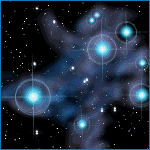
The sky's best known star cluster, the Pleiades in Taurus, is made up of hot blue stars. These stars are newborns by stellar standards: just 50 million years old.
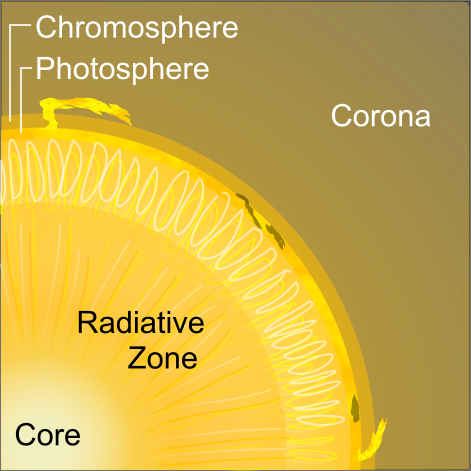
Anatomy of a Star: The structure of a typical, Sun-like star. The powerhouse of the star is nuclear fusion at its core, from where energy is radiated out to the outer 'surface' or photosphere.
The lifetime of a main sequence star is heavily dependent on its mass. Our own Sun - a fairly typical main sequence star - has been burning hydrogen for about 5,000 million years, and will probably continue to do so for another 5,000 million. More massive stars, though, have much shorter lifespans, often measured in mere hundreds of millions of years.
As the star's hydrogen supplies run out, its form changes significantly. Its core, now composed almost entirely of helium, begins to collapse upon itself, releasing further energy. This is sufficient to power an expansion of the matter around the decaying core, and the outer layers of the star swell to many times their original size. Meanwhile, the collapsing helium core reaches a point where fusion can proceed once again, this time fusing atoms of helium to produce carbon and oxygen. In this new phase, the temperature of the outer layers of the swollen star has cooled to give it a red light, and the resulting star type is known as a red giant.
Just as the star's original hydrogen fuel was eventually exhausted, so the star's new supply of helium fuel will also eventually be exhausted too. The next developments in the star's life will depend on its mass. If it is sufficiently massive, it can once again 'recycle' its fuel into heavier and heavier elements, until eventually its core is composed of iron. But beyond this limit no further processing is possible: the core collapses completely to form a superdense neutron star, while the outer shells of material are blasted away in a catastrophic event known as a supernova.
Our Sun, though, has too little mass to pass through this process. Once its helium core is depleted, nuclear reactions will cease, and the core will shrink to roughly the size of the Earth. The result will be an inert and highly dense stellar remnant, known as a white dwarf. Meanwhile, the outer shells of the giant phase will drift away from the dead core, eventually forming a bubble or ring of matter known as a planetary nebula.
However a star dies, much of its matter is spread back into the interstellar medium, whether through the supernova explosion or the formation of a nebula, and in that medium the processes that formed the original protostar are always at work. The matter cast away by one dying star may eventually find itself taking part in the birth of another.
|
|