Asteroids Clusters Comets Concepts Constellations Galaxies Moons Nebulae Planets and Moons Stars Surface Features

Menus

Catalogues

Tools and Links

Sirius
The Dog Star, Canicula, Aschere, Alpha Canis Majoris, 9 Canis Majoris
Proper Names
  Aschere
  Canicula
  The Dog Star
  Sirius
Bayer Designation
  Alpha Canis Majoris
Flamsteed Number
  9 Canis Majoris
BSC
  2491
HD
  48915
Constellation
  Canis Major
Right Ascension
  6h 45m 9s
Declination
  -16° 42' 58"
Distance
  8.6 light years
  2.6 parsecs
Magnitude
  Apparent: -1.4
  Absolute: +1.5
Spectral Class
  A0 White Star
Optimum Visibility
  January
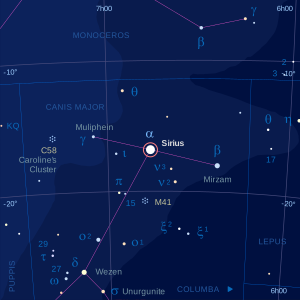
Location of Sirius
Brilliant Sirius, just nine light years from Earth, is in the north of Canis Major, the constellation of the Greater Dog. From this it takes its common name, the Dog Star.

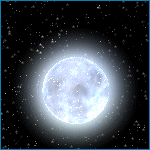
Sirius B
Sirius B is a white dwarf - the remnant of a once-giant star packed into a body smaller than the Earth. Though its nuclear fuel is now exhausted, it retains enough energy to generate a dim glow. Its great density also gives it tremendous heat: the surface of Sirius B is some six times hotter than that of the Sun.

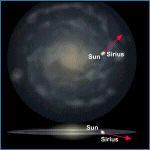
Relative Galactic Position of Sirius
The Galactic position and direction of Sirius relative to Earth's Sun. Note that, at this extreme scale, the two stars are effectively in the same place.

The brightest star in the sky is also one of the nearest to Earth: Sirius is just under 9 light years away. This is a binary star: the primary star, Sirius A, is orbited by a white dwarf known as Sirius B.

Sirius in the Night Sky
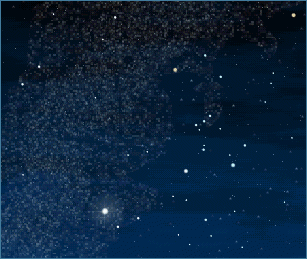
The sky's brightest star, Sirius, as seen on a winter evening in the northern hemisphere. The three stars of Orion's Belt point the way to this brilliant near neighbour of the Sun.

The name Sirius comes from its use in the Greek calendar. The time of year when this star rose and set with the Sun was the hottest part of the summer, and was given the name Seirios, 'scorching', a name that was acquired by the star itself. It played an important part in the Egyptian calendar, too, because its rising coincided with the annual flooding the Nile, and so with Egyptians' entire agricultural cycle. Indeed, the Egyptians went so far as to give it its own goddess, Sopdet (also known as Sothis).

Sirius is a luminous star in comparison to the Sun, and rather more massive (its mass is about double that of the Sun). In comparison with other stars, though, it is not notably luminous, and its particular brilliance in the sky is due to its being the seventh closest star to the Solar System.

Sirius is a binary system. As well as the bright white star we see in the sky, Sirius A, the system also contains a much fainter white dwarf star, Sirius B. The white dwarf has a mass very close to that of our own Sun. The two stars orbit one another over a period of fifty years.

The presence of a white dwarf in the Sirian system means that it did not always appear as it does now - at one time, Sirius B must have been a red giant star. Indeed, there is some slight evidence that it only completed its collapse to white dwarf status within the last few thousand years - ancient records seem to refer to Sirius having a reddish appearance, which may, just possibly, refer to the dying glow of Sirius B's red giant phase.


Indexes
  • Main Index
  • Star Names Index
  • Bayer Stars Index
  • Flamsteed Stars Index
  • Related Entries
  • Canis Major
  • Light Year
  • M47
  • Magnitude
  • Spectral Classification