May (Usually visible from southern latitudes) (not visible to the naked eye)
Notes
As is commonly seen in a reddwarfstar, the Sun's nearest neighbour is a highly active flare star, showing bursts of increased brightness at unpredictable intervals.
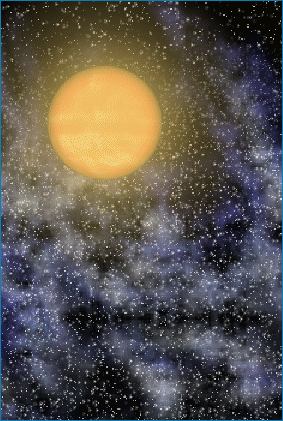
Though it is nearer to the Sun than any other star, Proxima Centauri is a tiny star that shines with a feeble red light, and is quite invisble to the naked eye.
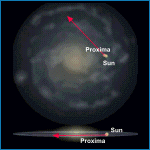
The Galactic position and direction of Proxima Centauri relative to Earth'sSun. Note that, at this extreme scale, the two stars are effectively in the same place.
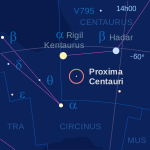
Strictly an outlying member of the Alpha Centauri or Rigil Kentaurus system, rather than an independent star, Proxima is a faint and inoffensive reddwarf. It is remarkable, though, as the Sun's nearest stellar neighbour, at a distance of just 4.25 light years. The relative motions of the two stars mean that Proxima and the Sun are actually getting closer together at a rate of about sixteen kilometres per second.
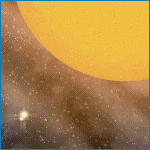
If humans ever travel beyond the Solar System, this will surely be one of the first sights they experience - the faint red-orange glow of the Sun's nearest neighbour, Proxima Centauri, against the backdrop of the Milky Way.
As an outlying member of the Alpha Centauri system, Proxima is also designated Alpha Centauri C (with A and B being the two main-sequence stars that form the main binary pair). Proxima follows an extremely distant orbit around these central stars, with a semi-major axis of some 13,000 AU (which equates to approximately one fifth of a light year). This extreme orbit means that Proxima takes more than half a million years to complete an orbit of the inner starsAlpha Centauri A and B.
As a faint reddwarf, Proxima has a low mass and a low luminosity, with an eighth of the mass of the Sun and a seventh of its diameter. Under normal circumstances, Proxima produces only a fraction of the light of the Sun, but this is a flare star, which means that at times it can produce flashes of extreme energy. This is due to the star's intense magnetic field, itself a result of the relatively undifferentiated internal structure of a reddwarf star. At times the energy of this magnetic field bursts out from the star's surface in a brief flare that radiates in wavelengths across the electromagnetic spectrum.
Proxima is orbited by at least two planets, and possibly more. Proxima b is a rocky world similar in mass to Earth, following a close orbit around the redstar in a period of a little over eleven days. Proxima d is a smaller world in a closer orbit still, racing around the star in a period of just five days. A third, much more massive, planet has also been proposed, but its status remains uncertain. If confirmed, Proxima c would appear to be a much more massiveplanet than the other two - a super Earth - at an orbital distance comparable with that of Jupiter around the Sun.



 Show on Sky Map