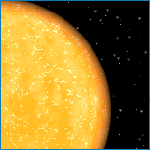
One of the nearest stars to the Solar System, Barnard's Star is faint reddwarf of considerable age, being at least nine billion years old, or twice the age of the Sun.
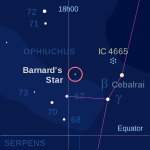
In the northern reaches of Ophiuchus lies tiny, faint Barnard's Star, one of the Sun's
nearest neighbours in space.
After Proxima and Alpha Centauri, Barnard's Star is the
Sun's closest neighbour in space. Nonetheless, it is a tiny, feeble
star and quite invisible to the naked eye.
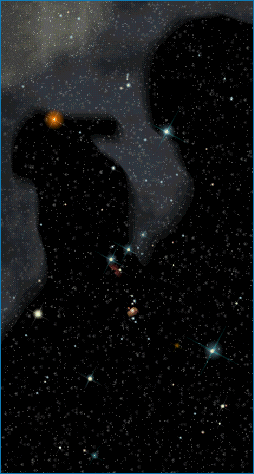
To an observer near Barnard's Star, Orion is still
clearly recognisable. Following the line of the Belt downwards and eastwards, though,
reveals a new, yellowstar of first
magnitude: our own Sun, nearly six
light years away.
Nearby Barnard's Star has a higher proper motion than any other star in the sky (where 'proper motion' refers to an object's movement across the celestial sphere). Since this image was captured, Barnard's Star has moved relative to the more distant background stars by some four arcminutes (that is, approximately the height of this image). Imagery provided by Aladin sky atlas




 Show on Sky Map