Asteroids Clusters Comets Concepts Constellations Galaxies Moons Nebulae Planets and Moons Stars Surface Features
The Electronic Sky Planet Wheel App

Menus

Catalogues

Tools and Links

Pyxis
The (Mariner’s) Compass
Genitive
  Pyxidis
Abbreviation
  Pyx
Right Ascension
  08h26 to 09h26
Declination
  -17.3° to -37.0°
Area (sq deg)
  221
Brightest Star
  Alpha Pyxidis
Optimum Visibility
  February

Derivation

Pyxis was introduced by Abbé de la Caille, and associated with the giant 'superconstellation' of Argo Navis. In naming the constellation, though, de la Caille encountered a problem: there is no Latin word for 'compass', because the Romans did not have them. To solve this, he chose the word pyxis, which literally means 'little box'. The full name of the constellation, not now used, was Pyxis Nautica, meaning 'The Mariner's Box' or 'The Mariner's Compass'.


Stars

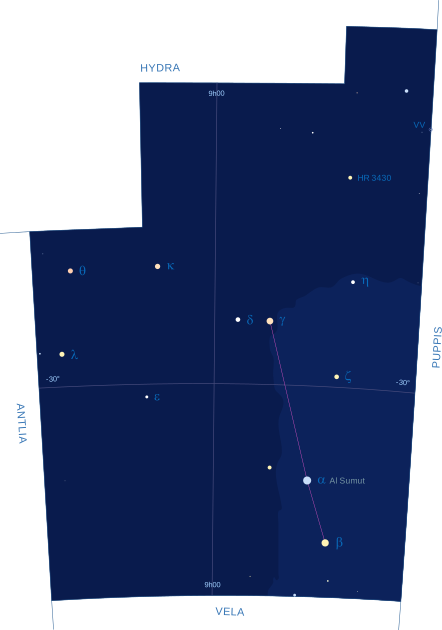
Map of Pyxis Though it lies on the plane of the Milky Way, there are few bright stars in this constellation. The brightest is Alpha Pyxidis, with a magnitude of just +3.7. It lies more than 800 light years away, but it is a highly luminous body and hence visible from Earth. The other stars of the constellation are a little closer, but all are fainter than magnitude +4.0.

Only one of the stars of Pyxis lies anywhere close to the Earth's solar system: BSC 3430 is a binary star, consisting of a pair of yellow dwarf stars, that lies 65 light years from the Sun.

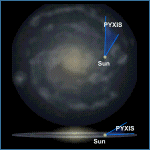
Relative Galactic Position of Pyxis
The stars of Pyxis fall within a slice of sky that lies within the disc of our home Galaxy, and so appear within the band of the Milky Way in the night sky.
Indexes
  • Main Index
  • Constellations Index
  • Related Entries
  • Antlia
  • Argo Navis
  • Hydra
  • Vela