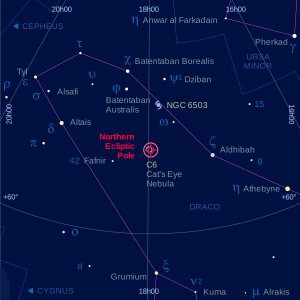
The Northern Ecliptic Pole falls within the coils of Draco the Dragon. By coincidence, it is closely aligned with the distinctive whorled shape of the planetary nebulaC6, commonly called the Cat's Eye Nebula, which currently lies less than ten arcminutes from the Ecliptic Pole in the sky.
The major planets of the Solar Systemorbit the Sun in a common plane, known as the plane of the Ecliptic. The Ecliptic Poles represent the ends of an imaginary line perpendicular to the Ecliptic plane, extending directly 'above' and 'below' it, with the Northern Pole lying in the central regions of the constellationDraco. The Earth rotates on its axis at an angle to the Ecliptic plane, and this means that the Northern Celestial Pole, based on the Earth's axis, does not coincide closely with the Northern Ecliptic Pole. In fact, the Celestial Pole pursues a slow circular path around the Ecliptic Pole, the Precession Circle, which takes more than 25,000 years to complete.



 Show on Sky Map