September (Usually visible from northern latitudes)
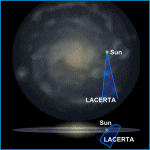
Lacerta outlines a region that falls between two spiral arms of our Galaxy: hence its stars
are generally distant and faint as seen from Earth.
Sandwiched between some of the most prominent and recognisable constellations in the northern sky lies this innocuous zig-zag of faint stars.
Derivation
The sparse region between Andromeda and Cygnus
was given various names during the seventeenth and eighteenth centuries. This constellation
might have become Sceptrum, the Sceptre, or even Frederick's Glory in honour of Frederick of Prussia. Ultimately, though, the name given
to it by Hevelius in 1687 was to survive: Lacerta, the Lizard.
Though Lacerta is relatively lacking in interesting objects, it does lie on the Milky Way, and
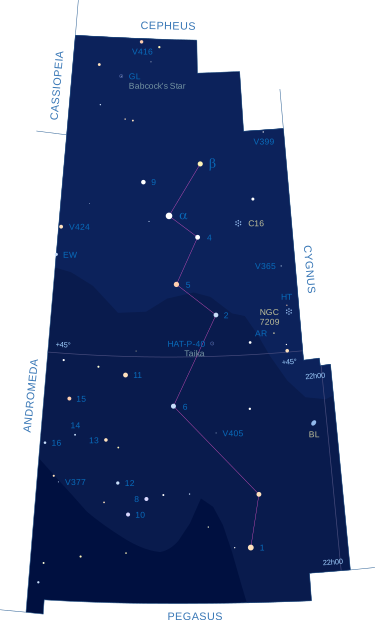
as we would expect it is not entirely devoid of features. In particular, there are two open star clusters
in its northern parts, designated C16 and Collinder 444, which are slightly too faint to be seen without a telescope. These
clusters both lie about three thousand light
years from Earth.
Far, far beyond these clusters is an unusual object, the first of its kind to be discovered. This is BL Lacertae, a huge
elliptical galaxy with a volatile core. The core variability can change vary rapidly
over short periods of time, and for this reason BL Lacertae was at first mistaken for a variablestar.



 Show on Sky Map