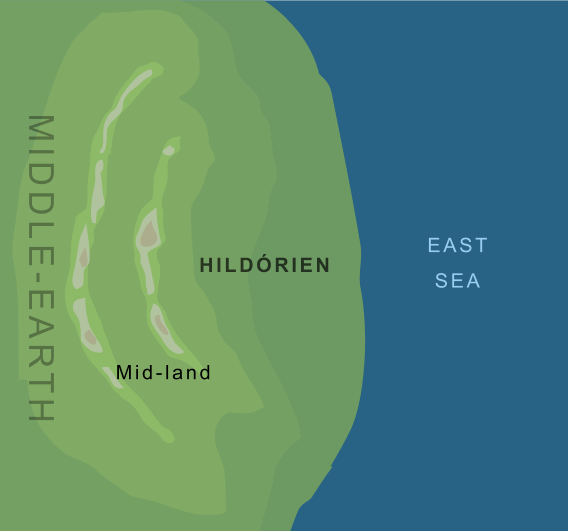
Approximate map of Hildórien2
Approximate map of Hildórien2
An ancient and forgotten land of Middle-earth, important as the place where the first Men awakened. The land took its name from those first Men, Hildórien, which means 'land of the Followers' (Hildor, the Followers, was one of many names used by the Elves to describe Men). The location of Hildórien is no longer known with any certainty, except that it lay in the middle latitudes of Middle-earth, eastward of the more familiar regions.3
When the first Men awoke here, the Elves had already been present in the world for millennia, hence their name of the 'Followers' for Men. By the time of the Awakening of Men, momentous events had already unfolded in the world: the Eldar had already travelled to Valinor and remained there for millennia; the Two Trees had been destroyed; and the Noldor had begun their return to Middle-earth. As the Valar sent the Sun into the sky for the first time, Men finally stirred under its new light (and so they were people of the daylight, while the Elves had been born beneath the stars).
When the Elves had awakened into the world long beforehand, the Valar had summoned them to Valinor to dwell in bliss. That decision had turned to disaster, and so no Vala came out of Valinor to seek the first Men and to teach them. Morgoth, however, learned of the newly-awakened Men. He left Angband (for the only time after his return to Middle-earth) and travelled to Hildórien, were he appeared to Men in a fair form. Many fell under his power in that time, but others abandoned Hildórien and began a long journey toward the West. There the Sun had first risen, and there, they had heard, the Valar could be found. That long journey would lead them across the wilds of Middle-earth and eventually into Beleriand, where they would give rise to the Edain.
Of Hildórien in later ages, no record remains. While the place where the Elves had awakened, Cuiviénen, was explicitly said to have been lost in later times, that is not said of Hildórien. So, possibly, a traveller into the distant East beyond the Sea of Rhûn might still perhaps have found their way to the land where the first of Men had come into the world, millennia beforehand.
Notes
1 |
After the Awakening of Men, Hildórien is not subsequently mentioned, and it may be that it was lost in the mists of time, like the Elves' place of awakening at Cuiviénen. On the other hand, Men awoke much more recently than the Elves, and unlike Cuiviénen, Hildórien is never explicitly said to have been lost. At least in principle, then, it's possible that the ancestral lands of Men were still inhabited by them until the time of the War of the Ring and even beyond. |
2 |
Hildórien is only shown on one very early sketch map, reproduced in volume IV of The History of Middle-earth. Though this map has little in common with later versions, the conception of Hildóien as lying on the far eastern edge of Middle-earth was clearly retained.
Incidentally, the region labelled 'Mid-land' was so named to indicate that it lay in the central parts of Middle-earth, between 'Northland' and 'Southland'. Though these specific names aren't seen in later works, the terms 'Northlands' and 'Southlands' did survive as general terms for broad areas of Middle-earth.
|
3 |
Understanding the placement of Hildórien is complicated by the fact the Tolkien seems to have changed his mind about its location or, at the very least, refined his views. Earlier references describe the land as being in the uttermost East, on the farthest shores of Middle-earth where it met the eastern sea (as shown in the rough map shown above).
Later references emphasise that Hildórien was in the middle regions of the world. These later accounts still place it far to the eastward of the known parts of Middle-earth, but - apparently - not so far to the East as in former versions. In Volume XI of The History of Middle-earth, Christopher Tolkien suggests a compromise approach, whereby Hildórien still lay on the far eastern shores of Middle-earth, but those shores were seen as being the middle parts of the world taken as a whole. (This approach does indeed address many of the difficulties raised by the apparent change, but not all of them, as Christopher Tolkien points out himself.)
|
See also...
Aftercomers, Awakening of Men, Dark Elves, Hildor, Lord of Men, Men, Men of Darkness, Men of the Three Houses, Morgoth, Powers of the World, Rhûn, Secondborn, Shadow of Morgoth, The Dark, The East, [See the full list...]Two Kindreds, Wild Men, Younger Children of Ilúvatar
Indexes:
About this entry:
- Updated 6 August
- This entry is complete
For acknowledgements and references, see the Disclaimer & Bibliography page.
Original content © copyright Mark Fisher 1997-2026. All rights reserved. For conditions of reuse, see the Site FAQ.
Website services kindly sponsored by myDISCprofile, the free online personality test.
How do your personal strengths fit in with career matching? How can you identify them? Try a free personality test from myDISCprofile.
 SHARE
SHARE