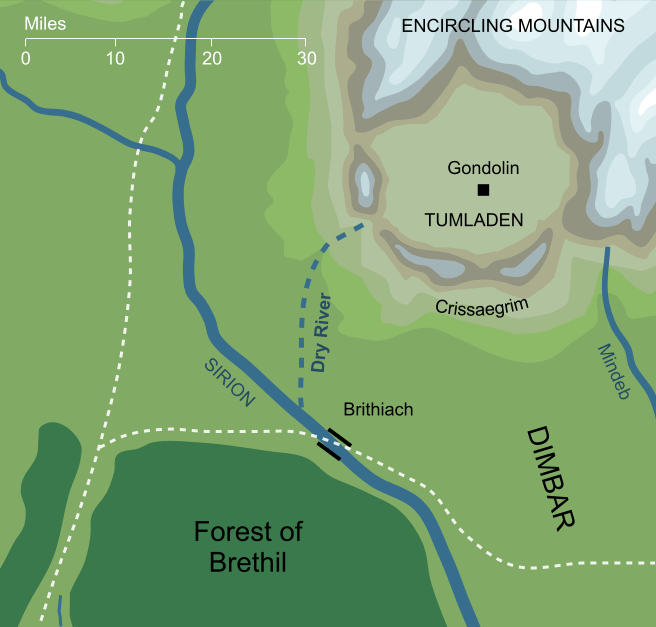
In ancient times, the wide circular valley in the mountains westward of Dorthonion had formed a lake with a central island. Out of this lake, a stream had found its way down through the rock and spilled out on the southwestern side of the mountains into a channel, and had flowed on southward to join the river Sirion. That lake and its stream dried away before even the rising of the Sun, and at the time of the Return of the Noldor, the place where the old lake had been had become a wide, bowl-like valley ringed by mountains. The stream's channel - now known as the Dry River - led to an empty tunnel that provided a secret way into the mountains that ran through them and down into the valley within.
Of the old river's bed, all that remained was a shallow gully that led westward and then southward as it emerged from the Encircling Mountains. At the feet of the sheer rockface, the old tunnel entrance was screened by thick thorn bushes that arched over the dry riverbed. Thus the Dry River's tunnel was almost impossible to find for those who did not already know its location, and it was only through the intervention of the Vala Ulmo that Turgon found his way into this tunnel. He followed it out into a cleft through the Encircling Mountains - the pass of the Orfalch Echor - that ran down into the empty plain beyond, with its central rock standing up from the flat valley floor.
Having discovered the Dry River and followed its course into the hidden vale, Turgon called on his craftsmen, who worked in secret for more than fifty years to raise the Hidden City of Gondolin. Turgon's people then removed from their former home in Nevrast and passed beyond the Encircling Mountains. No outsiders knew where the city lay, and its only entrance was through the Dry River and its tunnel, which led to a way guarded by Seven Gates.
Few passed back out along the Dry River after the settlement of Gondolin. At one time Turgon's sister Aredhel tired of life in the city and departed, returning years later with her son Maeglin, followed by her husband Eöl. Later, as Morgoth's power grew, Turgon sent out mariners to seek a way into the West and plead for the aid of the Valar. These messengers failed, but one of them, Voronwë, was able to return to Middle-earth and guide Tuor to the Dry River and thus into the Hidden City.
When the Union of Maedhros was formed, and Elves and Men readied themselves for a final battle against Morgoth, Turgon chose to join them. At that time an entire army passed out through the Orfalch and into the Dry River,1 before passing northward to join the massing armies of Turgon's brother Fingon. That battle proved to be disastrous, but Turgon's force was able to disengage and return in secret to the Hidden City. After that time, the tunnel into the mountains was blocked, and the Dry River no longer led to Gondolin's secret entrance. Even this did not save the city in the end, and when Morgoth finally learned where it stood, he sent his forces over the northern mountains, disregarding the old riverbed as the unprepared city fell to his Orcs and monsters.
Notes
1 |
At least, the army presumably passed out of the city via the Seven Gates and the Dry River. The Silmarillion is not specific, saying only that, '...Turgon had opened the leaguer of Gondolin, and was come with an army ten thousand strong...' (Quenta Silmarillion 20, Of the Fifth Battle: Nirnaeth Arnoediad). It seems slightly difficult to imagine ten thousand warriors passing through the dark tunnel and into the Dry River, but if Turgon had some alternative means for his army to pass through the Encircling Mountains, it is not described.
|
See also...
Dark Gate, Dark Guard, Dimbar, Elemmakil, Eöl, First Gate, Gate of Wood, Guarded Gate, Hidden Gates, Hidden Way, Mountains of Turgon, Orfalch Echor, Outer Gate of Gondolin, Outer Guard, Seven Gates of Gondolin, [See the full list...]Way of Escape
Indexes:
About this entry:
- Updated 7 June 2026
- This entry is complete
For acknowledgements and references, see the Disclaimer & Bibliography page.
Original content © copyright Mark Fisher 1998, 2001, 2014, 2026. All rights reserved. For conditions of reuse, see the Site FAQ.
Explore the history of the DISC profile, from ancient ideas about personality to modern theories, concepts and ideas.
 SHARE
SHARE